Pre Digital Photography
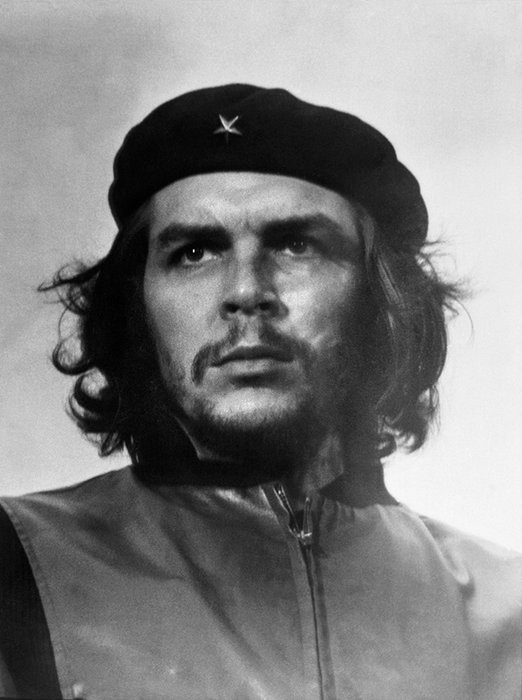
Photo by Alberto Korda using a Leica camera
The advent of compact, lightweight, and concealable cameras made the world of photography far more convenient. The Leica 35mm first hit the market in 1925 and quickly became the new standard of photography. The inventor, Oskar Barmack, utilized the 35mm film used in cinema and adapted it for camera use. The Smithsonian’s National Museum of American History explains, “Oskar Barnack, who work for Leitz, adapted 35mm movie film for still photography by doubling the width of the image to 24 x 36 mm. This format introduced with the Leica camera in 1925, became the standard for 35mm cameras”. Seeing as this year marks a hundred years of a revolutionary camera, I do believe we should celebrate and learn about such a pivotal technological advancement.
The Leica had 35mm film behind the lens mounted in a horizontal fashion, activating the shutter would expose one frame at a time. The exposure had to be wound manually. Early models used fixed lenses that were interchangeable. Bespoke at the time was the rangefinding feature which allowed for clearer images. All of these features in a compact package that could fit in a pocket allowed for great flexibility when taking photographs.
The Leica’s features and size allowed for the ability to capture more candid moments without having to plan to move an entire dark room, chemicals, and a litany of other items to take a single picture. This made street photography and photo documentary more accessible and far more convenient as people were not using an entire wagon to transport darkrooms.
By today’s metrics, the Leica is a simple mechanical camera with limited features. Being an entirely mechanical process with a minimalist design. As Matt Williams wrote in his recently published article about the Leica, “Barnack had not just created a tool - he had developed a system…It fit into the user’s life, not the other way around. Photographers could carry it in a coat pocket, shoot unobtrusively, and reload with ease.”
We have come such a long way from the days of Mathew Brady's Civil War photography. With the speed of the Leica, subjects could be somewhat more dynamic rather than standing completely still waiting for the exposure to happen on glass plates. As the CBS news article from the module points out, "You could take pictures before the battle, and after the battle, but not during the battle, because of the long exposures required." This made me ponder about setting up for photos prior to battle or capturing the moment, it was almost impossible without having to stage a photo.
As we have seen in this weeks readings, the evolution of the camera has been astounding. Looking at Weegee who used a Speed Graphic camera as seen in this ICP article. While he was known for having hefted this large camera around and doing simply breath taking work, when compared to the Leica - well, there is no comparison. Having to set up large flash bulbs or be inconvenienced by a cumbersome bulky camera made spontaneous and candid photography difficult. As Weegee points out in the posted video, "The easiest kinda job to cover was a murder because the stiff would be laying on the ground he couldn't get up and walk away or get temperamental, and he would be good for at least two hours. At fires you had to work very fast."
When comparing taking a photo on the Leica to taking a picture with a phone is incredible. I can simply point my cellular phone at a subject I want to capture, wait fractions of a second for my phone to do a myriad of adjustments to include: focus, adjust shutter speed, calculate light values, etc, and hit a button to capture a moment. I do not have to worry about dynamic movement, exposure times, having a finite number of exposures available, winding my shutter. I do not think about film development as Roger Fenton had to. As Professor Nordell points out in his second video when talking about the Leica, "..they used very small rolls of 35mm film, so with one roll of film you could have 24 or perhaps 36 pictures."
Photo taken by Orin Howell 9/27


Comments
Post a Comment